Search “Wake County building permit” and you will get the county’s permit portal, which is the wrong office for most of the people searching. If your house is inside the town limits of Cary, Apex, Holly Springs, Fuquay-Varina or Raleigh, Wake County does not issue your remodeling permit. Your town does, through its own inspections department, with its own portal, its own fee schedule and its own inspectors. This guide explains which work needs a permit, which work does not, who issues it in each town, roughly what it costs, and what happens if you skip it. It is written for homeowners planning a kitchen, bathroom or carpentry project; the rules for decks, additions and new construction are stricter and are only touched on here.
The short version
- Cosmetic work does not need a permit anywhere in Wake County: cabinets in the same place, countertops, backsplash, tile and flooring, paint, trim and crown molding, built-ins without new wiring, and like-for-like replacement of a faucet, toilet, light fixture or dishwasher that does not change the wiring or piping.
- Anything that touches the systems or the structure does need one, regardless of cost: moving or adding plumbing, adding or relocating electrical circuits, a new shower valve or drain, a new exhaust fan circuit, gas line changes, HVAC changes, and removing or opening a wall.
- Who issues it depends on your address, not your mailing city. Town of Cary, Town of Apex, Town of Holly Springs, Town of Fuquay-Varina and City of Raleigh each run their own inspections office. Wake County only permits homes in unincorporated areas and a few eastern towns it serves by contract.
- Your contractor pulls it. A licensed contractor applies in their name, schedules the inspections and meets the inspector. If a contractor suggests skipping the permit, that tells you something about the contractor.
Does my kitchen or bathroom remodel need a permit?
North Carolina’s building code says a permit is required to “erect, construct, enlarge, install, alter, repair, move, improve, remove, convert or demolish any building, structure, or service system,” and the Town of Cary’s own FAQ answers the question “almost always.” The practical exemptions that matter for a remodel are consistent across the towns, because they come from state law:
| Work | Permit? | Notes |
|---|---|---|
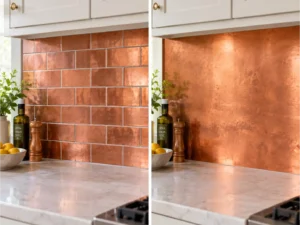
| New cabinets in the same layout, refacing, countertops, backsplash | No | Apex notes that cabinet replacement that changes the configuration, or any project over $40,000, does need one |
| Tile, hardwood, LVP flooring, paint, trim, crown, wainscoting | No | Cary lists “cabinets and casework, floor and wall coverings, moldings and trim” as exempt cosmetic elements |
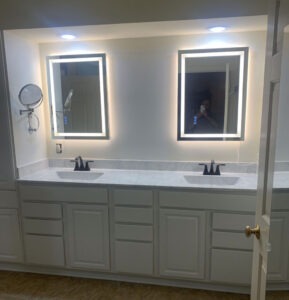
| Replacing a faucet, toilet, sink or vanity in the same spot | No | As long as pipe size and location do not change |
| Replacing a light fixture, switch or outlet in the same box | No | Same voltage and amperage, done by a licensed electrician |
| Like-for-like water heater replacement | No | Same location, size, fuel and venting, installed by a licensed plumber |
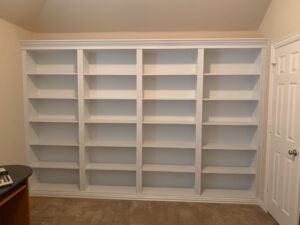
| Built-ins, mantels, closet systems without new wiring | No | Add an outlet or lighting inside the unit and the electrical work needs a permit |
| Moving the sink, range, dishwasher or any drain | Yes | Plumbing permit, plus electrical if circuits move |
| New shower valve, new shower drain, tub-to-shower conversion | Yes | Plumbing permit; electrical if a fan or lighting circuit is added |
| New circuits: island outlets, under-cabinet lighting, exhaust fan, range | Yes | Electrical permit |
| Gas line for a range or fireplace | Yes | Mechanical or plumbing permit depending on the town |
| Removing or opening a wall, adding a beam | Yes | Building permit; load-bearing changes usually need an engineer’s letter and plan review |
| Any nonstructural project over $40,000 | Yes | State threshold; also the point above which a licensed general contractor is required |
A typical kitchen refresh or a cosmetic bathroom update therefore needs nothing. A typical full kitchen or bathroom remodel needs a building permit with the electrical and plumbing trades attached, because the fan, the valve, the new circuits or the wall put it over the line.
Who issues the permit: the five offices
Town of Cary
Cary’s Inspections and Permits office is on the first floor of Cary Town Hall at 316 North Academy Street, open 8:30 a.m. to 5 p.m. Monday through Friday, and permits are applied for online through the town’s building permits portal. Cary’s FAQ lists cabinets and casework, floor and wall coverings, moldings and trim and like-for-like water heaters as work that does not need a permit, and everything that alters a plumbing, electrical or mechanical system as work that does. Fees are built from the town’s fee charts by project type and square footage rather than a flat residential rate, so ask the office or your contractor for the number on your project. Most of Cary, including Preston, Lochmere, MacGregor Downs, Cary Park and Amberly, is inside the town limits.
Town of Apex
Apex’s Building Inspections and Permitting department is at 322 North Mason Street, 919-249-3418, and publishes the clearest homeowner guide of the five. Its rule: a permit is required for any work over $40,000, and regardless of cost for anything involving load-bearing members or the addition of plumbing, heating, air conditioning or electrical wiring, devices or equipment. It specifically lists kitchen cabinet replacement that changes the configuration as permit work, and like-for-like fixture, dishwasher, disposal and water heater swaps as exempt. Apex’s residential fee schedule charges a flat minimum for alterations under 800 square feet: $150 for the building permit and $75 each for electrical, plumbing and mechanical, so a bathroom with plumbing and electrical work runs about $300 in permit fees.
Town of Holly Springs
Holly Springs runs permits through its Development Services department at Town Hall, 128 South Main Street, using the CityView online portal for applications, payments and inspection scheduling. Building permits start at $78 and scale with the trades and square footage involved; the town’s FAQ is candid that it often cannot quote a fee until it has reviewed the application. Permit questions go to the department’s permitting email or the town’s main line at 919-577-3111. Sunset Ridge, Twelve Oaks, Holly Glen and the other large subdivisions are all inside the town.
Town of Fuquay-Varina
Fuquay-Varina’s Inspections Department, at the municipal building at 134 North Main Street, enforces the state code inside the town limits and takes applications through its online e-permits system. The town’s fee schedule for the 2026-27 fiscal year charges $100 per trade inspection for building, electrical, mechanical and plumbing work on residential alterations, plus an $80 land use fee where one applies, so a remodel involving two trades is roughly $200 to $300. Fuquay-Varina is the town where the jurisdiction question matters most: a large share of addresses with a Fuquay-Varina mailing address, especially south and west of town, are outside the limits and permit through Wake County instead.
City of Raleigh
Inside the Raleigh city limits, permits come from the City of Raleigh Planning and Development department through the Permit and Development Portal. Residential remodels are filed as a single Residential Building Alteration/Repair permit that includes any plumbing, mechanical and electrical work in the same application, and many alteration permits do not require plans. Fees come from the city’s Development Fee Guide and online fee calculator, with the plan review fee due before review starts. The permit helpline is 919-996-2500. Raleigh’s process is separate from Wake County’s even though the county offices are downtown, which trips up a lot of first-time remodelers.
Wake County (unincorporated areas only)
Wake County Permits and Inspections covers homes outside every town’s limits, plus Rolesville, Wendell, Knightdale and Zebulon by contract. It issues one permit covering all trades at $75 plus $0.25 per square foot of the area being altered, which makes it the simplest and usually the cheapest office in the county. Its exemption list matches the towns: nonstructural work under $40,000 that does not touch plumbing, mechanical or electrical systems, like-for-like window, door, siding and water heater replacement, and fixture swaps by licensed trades. To find out whether you are in the county’s jurisdiction, look up your address in Wake County iMAPS; a planning jurisdiction of “WC” means the county, and a town name means that town.
What a remodeling permit costs in Wake County towns
| Office | Residential alteration fee basis | Typical kitchen or bath remodel |
|---|---|---|
| Town of Apex | $150 building + $75 per trade (under 800 sq ft) | $225 to $375 |
| Town of Fuquay-Varina | $100 per trade inspection, $80 land use where applicable | $200 to $400 |
| Town of Holly Springs | From $78, by trades and square footage | Quoted after application |
| Town of Cary | Fee charts by project type and square footage | Quoted after application |
| City of Raleigh | Development Fee Guide and fee calculator, plan review fee up front | Varies; see the calculator |
| Wake County | $75 + $0.25 per sq ft altered, all trades included | $100 to $150 |
In every case the permit is a small fraction of the project. On a $20,000 bathroom the fee is one to two percent. The real cost of a permit is the schedule: each trade needs a rough-in inspection before the walls close and a final inspection at the end, and the contractor has to plan the work around them.
HomePro pulls the permit on every project that needs one.
Kitchen, bathroom and carpentry remodels in Cary, Apex, Holly Springs, Fuquay-Varina and Raleigh, with owner Chris Muragas filing with the right office, scheduling the inspections and meeting the inspector. Call (919) 758-3683 or request a free estimate. See our bathroom remodeling and Apex service area pages.
Who can pull the permit, and the $40,000 rule
In North Carolina, any project costing $40,000 or more must be done by a licensed general contractor, and anyone paid to manage it must be licensed too. Below $40,000 an unlicensed contractor may legally do the building work, but plumbing, electrical and HVAC work must always be done by a contractor licensed in that trade. A homeowner can act as their own general contractor on their own home if they will live in it for 12 months after the work is done, and in most towns can do their own trade work on that basis too, with an affidavit. In practice, a remodeler pulls the building permit and either holds the trade licenses or brings licensed plumbing and electrical subcontractors who pull theirs. Ask any contractor who will be pulling each permit before you sign.
What happens if you skip the permit
Apex’s homeowner guide puts it plainly: lenders increasingly ask for permit records, and unpermitted work gets discovered at refinance or sale, when the owner may be required to open walls so the missed inspections can be done, and to pay retroactive permit fees. Beyond that, unpermitted plumbing and electrical is uninsurable in the sense that matters: a claim traced to work that was never inspected is an argument you do not want to have with an adjuster. And the inspections themselves are the point. A rough-in inspection is a second set of trained eyes on the waterproofing, the venting and the wiring before the tile goes on, at no extra cost to you.
How the permit fits into a remodel timeline
- Application. Filed by the contractor once the scope is set, usually alongside ordering cabinets, tile and fixtures. Simple alteration permits in most of these towns are issued within days; anything with structural changes goes to plan review and takes longer.
- Demolition and rough-in. Plumbing and electrical are roughed in, then inspected before drywall or tile backer goes up.
- Finish work. Waterproofing, tile, cabinets, fixtures, trim.
- Final inspection. The inspector checks the finished fixtures, GFCI protection, fan venting and anything structural, and closes the permit.
Permit questions Cary, Apex, Holly Springs and Raleigh homeowners ask
Do I need a permit to remodel a bathroom in Wake County?
If the shower valve, a drain, a fan circuit or a wall changes, yes. If you are replacing the vanity, toilet, floor and fixtures in place, no. And unless you live in an unincorporated area, the permit comes from your town, not the county.
Do I need a permit to replace kitchen cabinets?
Not for cabinets in the same layout, refacing or new countertops. Moving the sink or adding circuits for an island or lighting needs one, and Apex specifically requires one if the cabinet configuration changes or the project is over $40,000.
Do I need a permit for built-ins or crown molding?
No. Interior finish carpentry is exempt everywhere in Wake County. Adding an outlet or lighting inside a built-in needs an electrical permit. See our custom built-ins page.
How do I know whether I am in Cary or in the county?
Look up the address in Wake County iMAPS and check the planning jurisdiction field. Property tax bills also show the town. Fuquay-Varina and Holly Springs addresses are the ones most often outside the limits.
How long does it take to get a remodeling permit?
For an alteration permit without structural changes, typically a few business days in each of these towns. Add plan review time for a wall removal or beam.
Can the homeowner pull the permit and hire a contractor to do the work?
You can pull it as an owner-occupant, but then you are the responsible party for code compliance and the trade work still has to be done by licensed trades. It is simpler and safer to have the contractor pull it.
Sources
Everything above comes from the towns’ own published guidance and fee schedules, checked in October 2026:
- Town of Cary: Inspections & Permits FAQ (when a permit is and is not required, office location and hours).
- Town of Apex: When Is a Permit Needed? homeowner guide and the FY 2026-2027 fee schedule (one- and two-family dwelling permit fees).
- Town of Holly Springs: Town FAQ (permit fees and payment) and the CityView permit portal.
- Town of Fuquay-Varina: Inspections Department and the FY 2026-2027 fee schedule (building permit and inspection fees).
- City of Raleigh: How to Get a Residential Permit (alteration permits, portal, helpline).
- Wake County: Permits & Inspections FAQ (exemptions, jurisdictions, licensing rules) and the fee schedule.
Fees and office details above are taken from each town’s published fee schedule and permit guidance as of October 2026 and change periodically. Confirm current figures with the office before budgeting.